

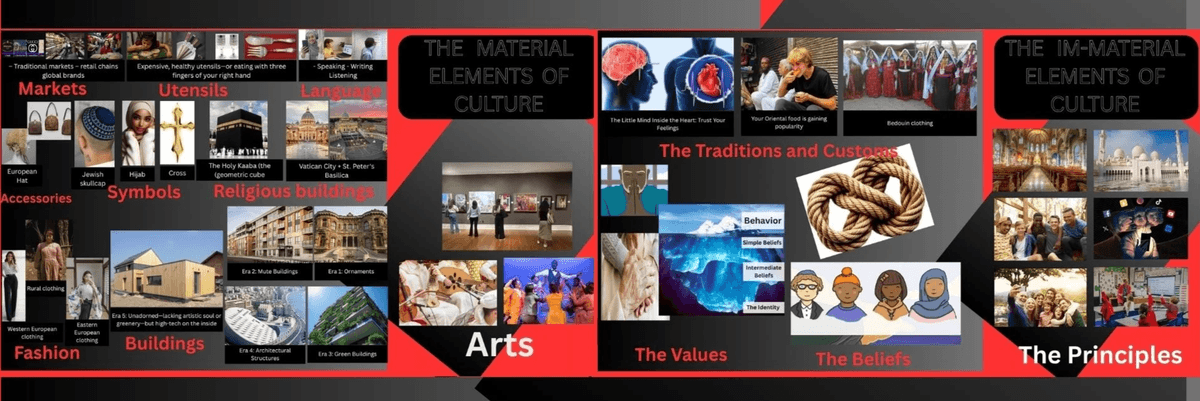
The proponent of culture, and how we also distinguish between it and the elements of civilization
Before discussing the elements of culture and civilization, it is important to note that there are two distinct schools of thought regarding how to define and distinguish between their respective elements.
The first school holds that culture consists of the material elements of civilization, whereas civilization comprises both material and non-material elements.
The second school maintains that culture is a collection of material elements—which we will discuss shortly—while civilization consists solely of non-material elements, rather than the combination of material and non-material elements proposed by the first school.
First: The Material Elements of Culture
Material culture refers to the tangible objects left behind by ancient and modern cultures within societies; it encompasses the things humans have used, experienced, and lived amidst—such as houses and furniture.
Consider your grandparents' home (if you knew it): Did it look the same as the home you set up when you got married? Was the furniture identical? Were the amenities—paint colors, décor, and technology—the same? Furthermore, have you ever entered the home of one of your father’s or grandfather’s acquaintances and thought, "This reminds me so much of my grandmother's house"? Perhaps the curtains, the chandeliers, the old-style kitchens, or even the bathrooms—tiled with traditional *qishani* (glazed earthenware) rather than modern ceramic—felt familiar. What does this signify? It means that homes bear the imprint of a country's culture, yet can vary from one location to another within that same country. Take Egypt, for example: Are the Nubian houses—adorned with vibrant colors, bold large-scale murals, and a palette that celebrates life—painted in the same style as homes in Greater Cairo or the Fifth Settlement? Certainly not. Homes reflect not merely the culture of their individual owners, but the culture of the broader society—and a single society comprises various sub-communities, such as rural, urban, Nubian, and Bedouin populations. Moreover, housing styles reflect specific historical eras; are the homes of Egyptians from the 1940s the same as those of "Generation Z" in Egypt today? Impossible, isn't it? That is precisely the point.
The Language
What constitutes a language? (Reading, writing, and pronunciation/speech).
What does this mean? It means that if native speakers lose one of these three pillars, they lose a significant part of the language itself. Today, Arabs are fond of foreign languages—often preferring them over their mother tongue. Indeed, some young Arabs speak English, French, German, or other languages as their primary tongue—with a fluency they lack in Arabic—viewing this as a mark of modernity and civilization. We can examine this issue through several aspects:
A - The Parents begin teaching foreign languages before the mother tongue (Arabic)
Consider the findings of the following studies:
Study 1: The Impact of Exposure to Foreign Languages on Early Childhood Language Development
While multilingualism is widely celebrated for its cognitive and cultural benefits, recent research suggests that early exposure to foreign languages may pose challenges to language development in young children. This review focuses on the findings of 17 studies to explore the complexities surrounding this issue, including:
Linguistic confusion
Delayed language acquisition
Slower vocabulary growth
Impaired language processing
Social and emotional effects
It also discusses mitigating factors and future directions for research and intervention. By highlighting this topic, the review aims to inform educators, parents, and policymakers about the nuances of language acquisition in bilingual individuals and the importance of providing tailored support to enhance early childhood language development in multilingual contexts.
Study Two: The Importance of Mother-Tongue Learning
Many children across the developing world receive very little schooling—a reality linked to the fact that instruction often takes place in a language they do not fully grasp. This practice leads to poor or non-existent
The opportunities for learning and acquiring knowledge and skills,
It creates alienating educational experiences for the child,
and contributes to high rates of school dropouts
and grade repetition.
To improve the quality of education, language policies must
Take mother-tongue learning into account; educational models that disregard the mother tongue during the early years can be unproductive and ineffective, and may even negatively impact children's learning.
The conversely, instruction in the mother tongue—
It particularly in the early years—enables teachers to perform their duties and learners to learn more effectively. For a long time, the issue of mother-tongue education was largely overlooked by policymakers. Although there are encouraging signs of a shift in policy attitudes toward a deeper understanding of the importance of mother-tongue learning, there is still a long way to go. While more governments are developing policies and programs that incorporate the mother tongue during early learning stages, there remains an urgent need to formulate better policies, ensure proper preparation for the introduction of second languages, and allocate sufficient resources for this purpose.
The Global Campaign for Education
believes that evidence points to specific areas that should be prioritized during policy development to ensure the creation of policies that are more responsive and sensitive to the nuances of mother-tongue learning.
Furthermore, language signifies
The Identity
Essential for cementing a sense of belonging to family and society.
The Communication
Effectively communicating with the surrounding community in the country of origin.
Risks of Neglect
Weakened communication with family and society.
We can draw certain insights from the experience of children learning Arabic as a first language in Arab and some African countries:
A – In certain Arab nations—notably the wealthy ones—young people rarely write to friends during social media chats (especially on WhatsApp) in Arabic; instead, they use the foreign language they have mastered, particularly English. English also serves as the official language in hospitals (for medical prescriptions), banks, and other sectors. Moreover, studies have shown that these young people have resorted to abbreviating this English text, replacing words with emojis—or "expressive images"—such as smiling, frowning, or disgusted faces. This practice represents a reduction of language to mere expressive icons, posing a significant threat to a crucial aspect of language: the ability to write fluently.
B – A study was also conducted regarding the phrase "I love you" involving three groups of people: Americans, Spaniards, and Japanese.
The participants in all three groups were asked to describe their feelings toward this phrase by writing a paragraph that incorporated it. As you may know—or as experts in the field understand—writing reveals the workings of the subconscious mind; one writes what truly fills one's thoughts. In fact, in some Western countries today, writing is even used as a tool in criminal investigations, where suspects in custody are required to write—a practice well-established in criminal psychology. Here is what the study found:
The Americans
They would say this phrase to anyone they met, without feeling the true meaning of the words at all.
The Spaniards
They would not utter the phrase "I love you" unless speaking to someone they genuinely loved.
The Japanese
They would never say it at all, except within the context of family
The conclusion drawn from this study
was that language truly governs our emotions; when speaking one's native language, one speaks from the subconscious without even realizing it.
C - In another study
The participants from various nationalities were asked—via a questionnaire—to describe a situation that made them very angry, using two languages: their native tongue and a second language they spoke fluently. What were the findings? From a psychological perspective, when people are not restrained by religion, morality, or social considerations (such as the need for social acceptance), they often resort to the vilest language—including hurtful profanity.
In the Psychologically context
The swearing actually helps alleviate the tension a person feels. The study found that when participants from different backgrounds wrote in their native languages, they used more profanity and abusive language, and expressed stronger negative emotions. Their writing also reflected their mental associations with their home countries—such as corruption, past abuse, or other negative experiences. Conversely, when they wrote in the second language they spoke fluently, their tone was far less angry; their writing style became more refined, influenced by the cultural norms associated with that language. Their conclusion was that if you truly wish to understand the emotions of someone—particularly an expatriate living in your country—ask them to write about something that angers them in their native language. This allows you to grasp their genuine feelings toward you, your country, their home country, and so forth—a method commonly recognized in the West.
D - In some developing Arab nations
One finds individuals who are functionally illiterate—unable to read or write—yet managed to reach the intermediate (middle school) level of education. This is truly lamentable. How did they advance? How were they deemed qualified to graduate from primary school? And who committed this injustice against them—a wrong that will haunt them for the rest of their lives? Moreover, it will affect those around them—whether future children or even friends—who are exposed to this "visual pollution," such as spelling errors and the like.
Thus, we conclude;
From the foregoing that language—whether spoken, written, or read correctly across all three aspects—is not a secondary matter but a top priority; it is a question of your own priorities.
The ools Utenesils in Daily Life
Consider the tools used in daily life—such as cooking utensils and eating implements. What is the cultural significance of these items, and why are they considered elements of culture? Indeed, they are integral cultural components. As you travel or view social media content from places you previously didn't even realize were inhabited, you encounter these variations. Let us look at some practical examples:
a- Eating with the fingers of the right hand (using three fingers)
In rural areas and among devout Muslims—some of whom might be perceived by others as strict—people eat using only their right hand; specifically, they use three fingers (the thumb and the two adjacent fingers). This practice follows the Sunnah (tradition) of the Prophet (peace be upon him) and reflects a lifestyle of simplicity, common among the hospitable people of the countryside. Notably, this method offers numerous health benefits—information you can look up online right now—as we prepare to address essential health literacy topics, God willing.
b- Eating with wooden chopsticks
This is the practice of Asians—including the Japanese, Chinese, and Koreans, among others. Why do they eat this way, even as we approach the end of the 21st century? Using wood instead of conventional stainless steel or other metal spoons offers significant health benefits.
C - Eating with spoons, forks, and knives of various types
By "types," we mean materials such as stainless steel, gold, silver, tin-plated copper, and so on. Does anyone actually eat with these? Yes; spoons, forks, and knives can be made of solid silver (or what is known as Alpaca/nickel silver), or they might simply be gold- or silver-plated. All of this is a matter of culture. But what kind of culture is this? Are you among the wealthy elite? And if you were, would you eat with solid silver or gold cutlery? Why? Is it for medicinal purposes—since some believe these materials offer healing properties for certain ailments (a topic we will explore in our "Health Literacy" section)? Or do you use them to boast and show off before your guests, demonstrating just how wealthy you are? Or perhaps you use them out of necessity—because you are a king, president, minister, or ambassador—and are thus compelled to do so? Suppose, for instance, you were an ambassador in a foreign country where such utensils were served; would you use them if you were a devout Muslim? Ultimately, you are governed by your culture wherever you go.
D - Do you lick your fingers after a meal?
What are you saying? That is truly repulsive—especially when in the company of others, where protocols and general etiquette apply! You are right about that. But are you a devout Muslim? A public health expert? Someone who is indifferent to the opinions of others? Or something else entirely? All of this, my friend, falls under the umbrella of the culture you have adopted—a culture you wish to practice wherever you happen to be.
The Buildings
Do you live in Egypt or abroad? Are you an admirer of old buildings? Are you an architect, or perhaps an interior designer? Why do I ask such questions? Because architects—whether in Egypt or elsewhere—have studied the architectural history of heritage buildings and the structures people have inhabited throughout the ages. You might be someone who enjoys visiting the seaside in Alexandria, for instance, to admire the old architecture; there, you will find buildings in the Greek style—dating back to when Greeks lived in Egypt—as well as Coptic styles and others. What does this signify? It means that the building you currently inhabit—whether located in one of Egypt’s most exclusive residential areas or in a working-class neighborhood—is an integral part of the culture of the Egyptians who live there. You might tell me, "I am poor; this is simply the lot life has dealt me."
I disagree with you on that point. Why? Because people imprint their nature and culture upon the places they inhabit, you might find Palestinians living in tattered tents—may God grant them relief, sooner rather than later—yet keeping everything spotless, polished, and tidy, while cooking meals that smell as appetizing as they look. Cleanliness—whether inside or out, and even when living with the most meager resources—is a reflection of your character, your image, and your culture. Consequently, if I were to visit an informal settlement and see piles of trash in front of buildings or inside canals, I would not blame the government or the local municipality—despite their evident lack of effort. Instead, I would blame *you*.
You have lived comfortably amidst this squalor—accepting the inevitable long-term risks of skin and respiratory diseases—without you or the area’s elders striving to resolve the crisis by escalating the issue to higher authorities or demanding accountability for the corruption and negligence involved. On a personal note, I adore Alexandria, Egypt; however, circumstances once required me to visit a specific location within my beloved city. I tried to hail a taxi to get there, but something strange happened: whenever I mentioned the destination, the drivers would simply drive off without a second glance. Eventually, my frustration peaked, and I finally managed to get into a taxi; emboldened, I asked about the mystery surrounding this place—why they refused to even discuss it. (Note: The honest driver who finally agreed to take me said he would drop me at the nearest accessible point, leaving me to walk the rest of the way.) As we spoke, he explained the root of the problem. It was an old plastics factory dating back to the era of the former regime. I was told—quite casually—that the place belonged to the "elite" and that no one dared to tear it down or even go near it.
I got out of the taxi and ventured inside, hopping from spot to spot like a child. Why such a wretched state of affairs, Alexandria? Because sewage was overflowing in the street—and not just that; ducks and chickens were actually swimming in the muck. As I walked further, I saw that the sewage water in the street had risen to a depth of a quarter of a meter. I wondered how the sick, the children, and even university students managed to leave this contaminated place every morning. I wondered, too, about the fate of those ducks and chickens swimming so nimbly and energetically in the pools of sewage—would they eventually be eaten? Where are you, members of the elite? Who are you? Please, let us know—not that we would ever do anything about it; it is simply curiosity about who has held such absolute control all these years.
Now... let’s return to the original topic.
The truth is—as you may already know—I am not an architect; I am just a blogger. However, I have read about this subject before. You will find that architecture has gone through distinct eras—or decades—that differ vastly from one another. I believe there have been five such eras from the beginning until now (though this specific detail might need verification). Most importantly:
The First Era (Ornamentation on facades and building interiors)
Ornaments covered building facades—whether Greek, Armenian, Coptic, Islamic, or otherwise. In many older buildings, especially in the entrance halls, you would find ceiling decorations—such as cornices—and numerous columns. Entrances featured natural marble rather than porcelain or ceramic tiles. The buildings themselves were towering, and the apartments inside enjoyed ample ventilation and sunlight; it didn't matter if the apartment faced south or north—that was simply the style of the era.
The Second Era (The rise of "blank" buildings)
Next came the era of plain, unadorned buildings—lacking ornamentation both inside and out—designed to cut costs and prioritize simplicity. Incidentally, most of Egypt remains stuck in this era to this day, with the exception of the so-called "new compounds" springing up here and there across the country.
The Third Era (The era of greenery)
In this era, greenery became a central feature of building exteriors, with plants adorning every single balcony. If you stood at street level and looked up, you wouldn't find a single balcony without that same signature style of greenery, color, and aesthetic spirit. This trend became widely popular abroad.
The Fourth Era (The Era of Unusual Geometric Shapes)
Here in Egypt, for instance, you find the famous Library of Alexandria; meanwhile, the late, brilliant Iraqi architect Zaha Hadid excelled in this style in Japan and many other countries.
The Fifth Era—the one we are living in now—is the era of shapes that appear old (perhaps even rusted) yet are simultaneously unusual and minimalist.
We have previously discussed minimalism—or *minimalism* as the West calls it—noting that it applies not only to clothing or lifestyle but also to architecture. If you were to search Google Images for "ultra-contemporary buildings," you would find structures that look deceptively old and starkly, almost jarringly, simple on the outside, yet house cutting-edge technology on the inside—technology the likes of which we may never have heard of before.
In short,
Do not dismiss these buildings simply because they stem from a specific local culture that has not yet expanded globally; they are, after all, a form of culture in their own right.
The Religious Sites
There is a book by Dr. Sherif Arafa—titled something like *How to Become a Human Being?*—which offers a high-level psychological perspective on humanity from various angles. In a chapter titled "Beauty," he discusses the human appreciation of beauty, noting that it is relative and changes with time, place, and context. For instance—though this specific example isn't in the book—people with darker complexions might be drawn to those with lighter complexions. However, that chapter drew my attention to beauty in things I had never imagined considering before, such as the ornamentation on ancient temples, churches, and great mosques, or even palaces in Andalusia and the Levant, like the Alhambra. Crucially, these decorative patterns—including those on Pharaonic temples—emerged alongside human existence on Earth, back when the human connection to nature was far stronger than it is today. Humans drew inspiration from nature and infused it with a human touch, reflecting the thoughts, efforts, and experiences of the individuals who once created these wall designs. Now, what is the connection between the ornamentation of sacred buildings and culture? Here, the culture is not merely local; it is tied to the religion itself—whether it is an Abrahamic or non-Abrahamic faith, a global religion or a local one. You may know, as I do, that the greatest religious diversity is found in Nepal, in Asia. There, you encounter various religions—mostly non-Abrahamic—each with distinct colors and attire; the clothing of Hindus differs from that of Confucians, Buddhists, and so on. Is this difference in attire merely to distinguish one religion from another? No; it is a matter of culture. Consider the concept of a logo: a great, universally accepted, and recognized logo must adhere to certain standards—such as using between three and five colors (though five is considered a lot for a single logo). Why is that? Consider how easily things are recognized: if a young child memorizes a club’s logo—or any other symbol—and points to it while naming it, that entity has succeeded without any significant effort. Similarly, religious attire evokes a sacred place and the people who revere a particular faith. Think of the Vatican: if you didn't know this before—as I once didn't—the Vatican is not merely a church; it is a fully independent city-state known as "Vatican City." It is the smallest state in the world in terms of both area and population, yet it houses the famous St. Peter's Basilica, the largest Catholic church in the world. If children—or adults, for that matter—were shown a cube and asked what famous object shares that shape, would they not immediately think of the Muslims' Kaaba? That is precisely the point.
The Markets
Are rural markets the same as chain store markets (brands known locally or globally)? Are traditional markets the same as duty-free shops at airports? Markets vary from one people to another, shaped by their respective cultures. In Asian societies—such as Japan, China, or Korea—fish are abundant. You might encounter vendors ranging from street hawkers and those displaying goods on the ground using primitive setups in traditional markets, to high-end stores charging premium prices. There are even markets featuring restaurants where you can select your preferred fish and cook it yourself right at the table while it is fresh, or have a restaurant chef prepare it for you. Some vendors might generously give you more than you paid for, while others might cheat you; honesty or dishonesty in the marketplace is not tied to a specific faith or religion, but rather to the presence—or absence—of conscience. You might find Western markets where vendors are incredibly generous and welcoming, never resorting to deceit, whereas you might encounter the opposite in Arab markets that appear outwardly religious. Let me give you one final example: A merchant from a prominent Arab country was engaged in a joint business venture with an Asian partner. One day, after finalizing their agreement, they went to a restaurant for lunch. The Muslim merchant adamantly refused to eat pork or drink alcohol, as these are forbidden by his faith. Yet, the Asian partner—who, incidentally, held no religious affiliation—was astonished to see that this same Muslim merchant was willing to engage in unethical practices if it meant higher profits: such as bypassing customs duties through bribery, committing commercial fraud against his own countrymen, and so on. The Asian partner was left in disbelief. This, quite simply, is the nature of markets and how they reflect the cultural differences between peoples.
The weapons
Regarding the weapons used: What connection is there between my culture—or the culture of the society I live in—and the weaponry employed by the army of my country? Didn't you say a moment ago that culture is local while civilization is universal? Most of the world's armies use ballistic and intercontinental missiles controlled remotely; they might even use chemical or biological weapons—such as agents for pandemics or genetically engineered insects. What is this? Are you a believer in conspiracy theories? Unfortunately, yes. Regardless, today's weapons are devastating. I won't even speak of nuclear arms, or even conventional ones that alter the Earth's ecology for a century or more. May God spare Egypt from war, and spare every nation—not just Muslim ones, in accordance with my faith, but any nation suffering from prolonged wars or armed conflicts. May the Lord of the Earth and Heavens bestow His grace upon them by averting war!
The Symbols
What are symbols? Are they the same as logos? No, they are distinct. While logos and symbols share the same goal—being instantly recognizable with minimal effort—a logo can be composed of words, symbols, colors, and perhaps geometric shapes. A symbol, however, is self-contained and self-explanatory; it requires no effort to identify. Examples include:
The Cross for Christians
The Hijab for Muslims
The small round cap (kippah) or the Star of David for Jews
...and other religious symbols.
Now, let’s take a test
WHO
We all know these letters stand for the World Health Organization; so, is it a logo or a symbol?
McDonald’s
Have you ever been driving or taking public transport with your toddler—barely a year and a half old—sitting beside you, when he pointed at McDonald’s and said its name? You might have shouted, "This kid is a genius, just like me!" and perhaps even got into an argument with your wife over it. But the real question is: how did this brilliant little boy know that this logo belonged to McDonald’s? The person who created the McDonald’s logo was a wizard. Why? Because the color palette is limited to just four colors (orange, red, blue, and a tiny black intellectual property symbol). A genius, right? He used "hot colors"—fine arts graduates, please look away; let us make a living! In the world of fine arts, red and orange are known as "hot colors" that grab the eye—and they are especially captivating for children. Do you remember which color your child learned first? Not only that, but the logo stimulates the appetite; your mouth waters—provided you enjoy that type of food—the moment you or your child see it. So now: is McDonald’s a logo or a symbol? The answer is up to you this time. So far, we have recognized the value of symbols in life—and there are many beyond just religious ones. Take the Pharaonic "Key of Life" (Ankh), or the owl: in the West, it symbolizes wisdom, whereas in the East, it is associated with envy or a nagging wife. Consider the scarab beetle: in the West, it signifies good luck, while in the East, it might just get swatted away with a slipper. And so it goes—not to mention modern symbols like hashtags or "B2B" on LinkedIn. So, if symbols are so cherished by those who create and propagate them, why does the West oppose certain ones—such as the hijab, the cross, or the Star of David—in schools, parliaments, government jobs, or media outlets (as seen in France and many other Western nations)? Perhaps it is because most wars are rooted in religion, and most armed conflicts stem from tribal customs and traditions. There are—according to Pew Research projections for 2026—nearly 4,000 religions on Earth, each with its own messenger, deity, and holy book. If they were to open the door to this, the world would be flooded with such emblems, potentially sparking wars and armed conflicts in places where they wish to avoid them. I am not taking their side—nor do I receive a single penny or euro from their budgets. I can tell from your expression that you suspect I am trying to quietly push an international agenda favorable to the West; I assure you, I am not. I am simply trying to analyze their reasoning—though there is no definitive proof of this specific motive. We take no stance for or against anyone who wears, upholds, or defends a religious symbol, whatever it may be; that is a right. They, too, may have a valid point. However, consider this: a symbol represents *culture* rather than *civilization*; culture is local, not universal. This distinction does not apply to our religions, of course—we in the East love our faiths, thank God.
The Hairstyles
Does it the influence of Turkish series? Here in Egypt, among older, non-hijabi women from the upper class (the elite), you might feel—upon seeing them—as though you have just stepped out of a Turkish drama. You see young women all sporting the exact same hairstyle; if you saw a group of them from behind, you wouldn't be able to distinguish one from another at all. Look at actresses in Egyptian films and series: do you see anyone who doesn't have that "Hollywood smile" and a Barbie-like physique? It is as if they have just stepped out of the mold of Barbie and Baby Born dolls; these measurements have become the primary model and the sole standard of beauty in their eyes. This fixation on the Barbie-like body ideal has contributed to psychological issues for an entire generation of girls. Mind you—this is not a call for being overweight or obese, or anything of that sort. Just recall the hairstyles of the 1960s or even the 1940s in Egypt... That is what I mean—it is a matter of cultural style.
The Accessories and Adornments
It is a matter of culture: sometimes people wear anklets, other times ties to work; sometimes they carry crossbody bags, while at other times they wear them on their backs; sometimes they wear high heels, and at other times—even at weddings—they opt for sneakers. There are even instances where directors—recognizing those with expertise in historical accessories—enlist them to play roles more pivotal than those of the actors and actresses themselves. These things are not merely fleeting fads. A bride might wear a diamond tiara (an imitation one, of course), or perhaps flowers, or even forgo the wedding veil entirely. Why? Because it is a "trend." And who sets these trends? You might say, "Global fashion houses." I would agree. But why do you follow suit? Do you not have a mind of your own? Yes, I do; and we have innovative designers across the Arab world who have achieved global recognition. That is excellent. What matters most, however, is that you consider what truly shapes *you*—what defines your history and your principles. After the January Revolution, a trend emerged—though I honestly do not know why it didn't last; perhaps I simply missed it—of inscribing quotes, aphorisms, and folk proverbs onto school bags, university students' bags, and even T-shirts. It was an attempt to refine the Arabic sensibility and assert our identity to the world. After all, they are not the only ones capable of innovation, are they?
The Attire
Are you a doctor, a pharmacist, an architect, or a blacksmith?
Why did you choose these specific professions? After all, if you practice one of them, you likely wear a recognizable uniform; the moment someone sees you, they instantly identify your profession without any effort. Is this a coincidence? Did the person who originally designed and created these garments thousands of years ago do so by chance? Here is another question: if you were to wear an architect’s hard hat while inside a pharmacy, would people think you were crazy? Yes, certainly. A third question: suppose you are an educated person with broad knowledge, and a doctor comes to treat you—would you stand there pontificating about what you know, or is the mere sight of that white coat enough to leave you speechless? That is the power of attire. Let me share a few studies on clothing with you; you can find more yourself simply by searching in English (e.g., "the psychology behind casual/formal/evening/children's wear," etc.). Let’s begin.
First Study: Formal Attire
A Western study examined the impact of wearing formal attire at work—specifically on women—regarding their own performance and that of their colleagues. The findings indicated the following:
The Impact on others
Increased respect for women who dress modestly and with dignity—while maintaining a formal style (such as suits, blazers, ties, and loose-fitting trousers).
The Impact on the woman herself
She was found to be more productive, decisive in her decision-making, and less prone to engaging in casual side conversations that distract from her primary work tasks.
Second Study;
The Men Wearing Formal Attire at Work
The researchers surveyed a group of men—specifically bank employees and executives—wearing formal work attire and found them performing their duties impeccably. To further the study, some executives took leave and then unexpectedly arrived at work in sportswear. The result was chaotic: other employees and bank customers rose from their seats, and an uproar ensued within the bank. The question arises: the manager or executive remained the same person, yet behavior changed completely—100%—simply due to the change in attire.
From these studies, we can draw a few general conclusions
1- Are Muslim women compelled to wear the hijab because of this? We do not know—it is merely a thought. I once heard from someone returning from abroad after a long time who observed that, while most young women in an Arab country wore the hijab, their clothing was immodest—such as tattered, ripped trousers—even though they wore headscarves. He perceived this as a widespread phenomenon rather than one limited to just a few individuals.
2- It is preferable for work attire to be modest for both genders in order to enhance productivity.
The Arts
Are the arts considered forbidden in certain religions? If so, why did God—the Creator of the earth and heavens according to Abrahamic faiths—imbue nature with such scenes: seas, rivers, lakes, and oceans at sunrise and sunset; a vast array of birds in diverse colors, species, and sizes; the underwater world of fish; and the vibrant hues of butterflies? Even sands and mountains vary in color depending on the region. No matter how renowned an artist might be—whether surrealist, expressionist, or otherwise—they could never match the artistry of the Creator, Glory be to Him. In fact, artists often derive their designs—even in fashion—from sources like reptiles, adopting unusual color combinations and intricate, unconventional geometries. I am referring specifically to Islam here. Did Al-Andalus of the past (modern-day Spain) not have female singers? They certainly did. While I am no historian—possessing only a superficial knowledge of the subject—I know that the people of Al-Andalus were Umayyads, not Abbasids; this means they emerged during the early golden centuries of the Prophetic message—an era praised by the Messenger of Allah (peace be upon him). To be clear, I am not advocating for women to sing, wear revealing clothing, or the like. I simply infer from this context that God Almighty would not bestow a unique talent upon someone only for it to be buried. Rather, God establishes laws and guidelines. To the best of my limited knowledge, Islamic scholars distinguish between two types of singing: the forbidden and the permissible. Permissible forms include songs about patriotism, a mother’s love for her children, or praise for nature and the Creator—alongside, of course, religious eulogies and other such expressions. More importantly—though this is not strictly a religious or Islamic discussion—the core question is: what kind of arts constitute "culture"? Is belly dancing, for instance, considered culture? Regarding any form of local art—does it truly express your identity as an Egyptian, for instance? Would you like your country’s artistic landscape to be defined by this particular genre? Do you enjoy theater? Whether it is comedy, tragedy, or science-based drama—perhaps with a touch of humor to lighten the scientific subject matter? Consider Shakespeare, the renowned English writer: it has been over a century since his death, yet he is celebrated annually with the same fervor as a national holiday. His home—modest by the standards of wealthy Englishmen—has been transformed into a museum visited by people from all over; and yet, he was merely a writer. Is writing, then, an art form? Indeed it is. Certain words can captivate you as deeply as music, seizing your mind entirely. While poetry, prose, and rhetoric are the forms of writing typically recognized as art, what is it that makes Shakespeare a writer celebrated a century after his passing? Do the English simply have time to spare? Certainly not. To the best of my limited knowledge, Shakespeare was a pioneer who wrote plays incorporating science, physics, and other complex disciplines. At a time when the Church in the West forbade scientific inquiry, his writings represented a rebellion—even a revolution—against the status quo. That is why the English regard him as a paragon of innovation and a writer whose pivotal role in the Western scientific revolution will never be forgotten.
Now... what does Shakespeare have to do with us? Isn't that English culture, rather than Egyptian or Arab?
You are right about that, but let us consider the matter carefully. If you share my view, let us thank God; I once read a study in the West suggesting that "you are what you listen to"—yes, exactly that. They categorize people based on their listening habits: those who love classical music are classified in a certain way, while rap enthusiasts are categorized differently. I do not know exactly how they would classify the fans of *Mahraganat*—that famous Egyptian genre—or those who enjoy the kind of noise that pollutes hearing and sight, clouds the mind, and causes other such calamities. More importantly, however, aristocratic art forms—such as opera and classical theater (whether scholarly or tragic, featuring humor that softens the tone of quasi-political commentary)—are undoubtedly refined arts. We certainly do not believe that the Lord—Blessed and Exalted be He—dislikes them.
Let us now explore the non-material elements of culture—elements that some anthropologists view not merely as culture, but as extending into the realm of civilization...
1- The Traditions and Customs
The Traditions
What we understand from religion—as opposed to mere tradition—is that one should not simply become accustomed to something until it becomes a habit, especially if that habit conflicts with the religious principles one follows. Let us suppose, for instance—God forbid—that your father lacks moral discipline. There is a popular Egyptian proverb that says, "A corrupt person may emerge from the loins of a scholar, and vice versa." In such a case, religion instructs you not to imitate your father, while simultaneously requiring you to honor him and treat him kindly. Thus, religions came to dismantle obsolete traditions and replace them with new customs that are beneficial to you on both personal and collective levels, given that we are social beings who cannot live in isolation.
As for habits—which stem from repeated action—the Arabic word for a festival or holiday (*Eid*) is derived from the concept of returning, because it recurs annually at roughly the same time. Psychology suggests that if you wish to adopt a new habit—say, becoming a "morning person"—you should gradually force yourself to wake up ten minutes earlier each day than your usual time for at least 21 days; eventually, it becomes a habit that no longer feels burdensome (though, of course, there are always exceptions).
Now, are traditions and habits considered *‘urf* (customary norms)? And what exactly is *‘urf*? The term stems from the concept of mutual recognition or consensus (*ta‘aruf*); specifically, it refers to practices agreed upon by the wise and virtuous members of a society. *‘Urf* is particularly prevalent in tribal settings rather than cities; figures like the tribal chief or the village headman (*‘umda*)—and other such titles—still hold significant status in certain rural or Arab communities. In reality, some of the outdated customs and traditions people cling to border on being customary norms (*‘urf*). It is worth noting that in many parts of the Arab world, social life is governed more by customary norms than by religious law—we previously cited the example of Bedouin women in Sinai. The danger arises, however, when these norms contradict logic or violate core tenets of religious faith. Finally, are traditions and habits considered "civilization" or merely "culture"? As previously discussed, culture is local, whereas civilization is global. Consider this example: if you are an Egyptian living in the United States and you eat *koshary* or hot *ta’ameya* (falafel) there, you are effectively sharing a part of your civilization with the outside world. What about harmless traditions—such as burning incense on Fridays while living in Japan? Since the Japanese are known for burning incense every morning, not just on Fridays, would your Arab tradition of doing so cause them any offense? Certainly not; therefore, as long as you can carry your customs and traditions with you wherever you go, they constitute a civilization, not merely a culture.
2- The Beliefs
Where does the word *aqidah* (belief/creed) come from? It stems from the concept of a *uqdah*—a knot. If you were to tie two ropes together tightly, could anyone—no matter who—untie them while you held fast to that knot and guarded it? No; it would require force—coercion, forcibly taking it from you to undo it, or something similar. Now, consider that beliefs (*uqdah*) reside in the heart. A Western study has found that the heart contains a "little brain"—possessing neurons that think, plan, and analyze—and is directly connected to the brain. In our daily lives, we say, "The heart is the seat of emotions." And what are emotions? There are many, including love, hatred, fear, sadness, and disgust, among others. Do you think these emotions were created in us never to be experienced, not even once in our lives? Impossible; they serve a purpose. Without the instinct of fear, our ancestors would not have survived the dinosaurs; without the instinct to eat, most of us would have perished, and so on. Thus, emotions are vital. The question arises: if the general public says "the heart is the seat of emotions" and scientists say "the heart contains a little brain," whom should we believe? Both. We accept that it holds emotions and also that it possesses a form of intelligence. Someone might tell you, "I dislike so-and-so for the sake of God." When you ask the reason, they reply, "I don't know; I just don't feel at ease with him." Trust their feelings—provided they are naturally truthful, sincere, and do not prioritize factional interests over the public good or the well-being of the person before them. Heartfelt emotions—especially love and hatred—are not based on flawed decisions; rather, they think and analyze, and can even make decisions on your behalf. Consider this study—or rather, the many studies that exist on this subject—and I invite you to watch an animated film about emotions called...
Inside Out: Guessing the feelings
3- The Values
does the values differ from the next point (The principles)?
Yes, certainly. Values are governed by principles, whereas principles are not governed by values. Consider the example of a constitution: where do a country's constitutional or legal provisions come from? In Egypt, for instance, they originate from various sources—including, but not limited to, Islamic Sharia and French law. Based on this example, what are the principles and what are the values?
To simplify:
The Islamic Sharia, French law, and the like represent the *principles*. The specific laws themselves are merely *values* proposed by some to facilitate interaction among people within a society.
Regarding the individual values
Where do they come from? Values such as "do not lie," "do not betray," and "do not steal"—where did you acquire them, whether as a Muslim or a Christian? They come from sacred texts; indeed, most Abrahamic religions—and even some non-Abrahamic ones—share certain universal human values. This is not a call to merge religions into a single "Abrahamic faith"—a concept we reject entirely, however little weight our opinions may carry. Proponents of "Life Coaching"—an art distinct from general "human development" in several key respects—argue that it teaches you how to think and how to identify your emotions. It is not about a simple "1+1=2" formula for living life. The program features a crucial introductory course—divided into several lectures—that explores your makeup (thoughts, emotions, etc.). Most importantly, it helps you understand when, where, and how you formed the values that will stay with you for a lifetime. While these values might waver at times, they can return even stronger than before. The program outlines three stages of value formation—values that will guide you for the rest of your life—using the metaphor of an iceberg. As you know, an iceberg has three parts: two-thirds lie underwater to anchor the structure (much like mountains anchor the earth itself, preventing it from destabilizing). The deepest underwater section represents "Identity," while the middle underwater section represents "Core Values." These are shaped by your life experiences—such as growing up in a religious, respectful, or—God forbid—dysfunctional family, or perhaps in an environment where begging is the norm. In such cases, your values would differ drastically; theft might be viewed as essential rather than forbidden, shameful, or illegal. The third underwater section consists of "Simple Beliefs," which are closely linked to your behavior; these are beliefs you adopted relatively recently, rather than in your pre-twenties or mid-life years. So, what is the benefit of all this? Life coaching explains that the remaining part of the iceberg—the section above the water—represents "Behavior." Your behavior acts as a mirror, reflecting the thoughts and values you have cultivated and lived by throughout your life.
4 - The Principles
As previously mentioned, principles are the source from which values are derived—stemming from influences such as family, school, media, places of worship (mosques or churches), and peers. These are not merely values we have cultivated over the course of our lives; rather, we internalize them unconsciously, acting upon them as habits without truly knowing their origins. In Western management theory, the prevailing view is that to execute a task, one must break it down into smaller components; for them, a "task" is simply a specific objective, whereas its actualization—or the path taken to achieve it—represents the ultimate "end" or purpose.
الروابط
