

#We_ will_ address_ each_ type_ of_ illiteracy_ separately_ in_ this category_ given_ the_ importance_ of_ the_ subject
This is not a mere article; the concept of "civilizational illiteracy" cannot possibly be encapsulated in a single piece. So, a word of advice: if you are not fond of deliberate, attentive reading, do not trouble yourself with this file at all—leave it to those who are interested.
Here is what you will read
A preamble introducing the topics to be discussed.
What is anthropology, and what does it study?
How can the average person distinguish between culture and civilization?
The stages of civilizational decline and the stages of civilizational resurgence
A look—however superficial—at modern civilizations (as opposed to ancient ones), given the limitations of time and a single lifetime.
An overview of Samuel Huntington’s "Clash of Civilizations" theory.
An Introduction
In previous articles, we established that illiteracy is not merely the inability to read and write—a common misconception. That is simply one form of illiteracy found in both the East and the West. While the West achieved zero literacy-related illiteracy long ago, the Arab world—or rather, certain Arab nations—remains mired in this deplorable form of illiteracy. In some Arab countries free from war, illiteracy rates hover just below the 50% mark; for instance, a 2011 Pew study revealed that approximately 54% of the population in one Arab nation lacked basic reading and writing skills—a figure that has only risen since. Notably, this country is not at war.
Ironically, the other half of the population is highly educated, with many individuals holding multiple post-graduate degrees. Returning to our main topic: other forms of illiteracy—such as the "cultural illiteracy" we are discussing—are shared challenges affecting developed nations just as much as developing or underdeveloped ones.
A question naturally arises here: given that the Arab world and much of Africa are plagued by war, armed conflict, and—at times—abject poverty, while only a few nations are on the path to development (and an even smaller number in the Middle East are wealthy or extremely wealthy), the majority face unfavorable circumstances. Can these people really be expected to forgo the daily struggle to put food on the table in order to learn about civilizations and overcome their illiteracy? ...civilizational matters? Is this the duty of the hour? Is it the top priority? And what do I gain, on an individual level, from educating myself about the civilizations of other nations? Will it put bread and food on my table today?
I will not answer you right now, for the subject branches out into matters of great importance—some or all of which I may discuss, depending on time and comprehension. Perhaps this introduction does not fully serve the purpose of this dossier, nor does the article quite meet the ideal standard; yet, I have kept it brief intentionally, so as not to dwell on the preamble at the expense of what matters most: the content itself. Finally, in this context, I can only echo the words of an Arabic song: "Love of homeland survives only when hunger dies."
What does anthropology study, in brief?
The anthropologists study civilizations and cultures, but their field is vast and branches out into several specializations, such as:
The Cultural Anthropology
Focuses on the study of the customs, values, beliefs, and social systems of various peoples, whether in the past or the present.
The Archaeological Anthropology
The investigates ancient civilizations through artifacts and material remains to understand how people lived and evolved over time.
The Biological Anthropology
Concerned with human evolution, genetic diversity, and the relationship between humans and the environment.
The Linguistic Anthropology
studies the role of language in shaping culture and communication among societies.
In other words,
anthropology combines the study of the past and the present—as well as the material (artifacts) and the intangible (culture and language)—to form a comprehensive picture of humanity across different times and places.
The Difference Between Culture and Civilization
The Culture
We have selected Clyde Kluckhohn’s definition of culture for you.
Clyde Kluckhohn defined
The culture as a social heritage passed down to individuals from the society to which they belong—a legacy shaped by the lifestyles of the people who lived within that society. In other words, it encompasses the information a person stores in books or within their own memory.
From Kluckhohn’s definition, we understand that...
The culture varies from one society to another; it is not uniform across all societies. Each society possesses a unique culture and distinct ways of life that set it apart from others—manifested in differences regarding customs, traditions, and beliefs. Yet, a question arises: can culture differ—whether radically or partially—within a single society? The answer is yes. Consider this scenario: imagine two individuals from the same country—sharing the same social status, age, gender, and educational level—but one is from an urban area while the other is from a rural area. Would their lifestyles and behaviors in various situations—such as during times of joy, sorrow, or other shared human emotions—differ based on that urban-rural divide?
The Civilization
The Civilization: the Linguistic Definition
The term "civilization" is defined as the antithesis of Bedouin life and the desert; it refers to the construction of villages, cities, and inhabited dwellings.
The Civilization: A Terminological Perspective
The Civilization is defined as a social system that enables humans to advance their cultural output; it is also defined as the collective human endeavor involving thought, invention, and discovery aimed at achieving a better life.
We can illustrate the distinction between the two using a simplified, non-academic example: culture tends to be local, whereas civilization often transcends continents—or at least crosses national borders to extend into other countries. Let us consider a few examples from human history
Greek civilization
Hellenic civilization
Phoenician civilization
Pharaonic civilization
Islamic civilization in Al-Andalus
Let us consider the latter as a higher-level perspective: where is Al-Andalus (or modern-day Spain) located? In the West or the East? Naturally, in the West. And where did Islam originate—in the East or the West? In the East, of course. Thus, the migration of this civilization from East to West demonstrates that it is not merely a local culture but a global civilization from which anyone can benefit. If you travel to Spain today, you will find historical structures that still bear the imprint of Islamic civilization; you will even find musical instruments in museums dating back to the era of the Muslim presence following the conquest of Al-Andalus. You may also have heard of *Muwashshahat* (Andalusian poetic songs), which are an Islamic creation.
From this, we can also draw a cultural example to form a vivid mental image of the distinction—allowing us to easily differentiate between culture and civilization from now on.
First Example – Within Egypt –
In beloved Sinai, women wear a wide red or black belt around the waist over their *galabiya* (or *abaya*). Red is worn by unmarried women, while black is for married women or those who have been married. This is a matter of custom—specifically, a social convention established by tribal elders or community leaders, a practice most common among Bedouins and Arab tribes. Now, the question arises: do all women across Egypt—in Cairo, Alexandria, Ismailia, and so on—follow this same practice? Of course not.
Second Example – In China –
We are all familiar with the Silk Road; for thousands of years, it was renowned for the silk trade in China. Today, however, it has evolved into a transcontinental free-trade network spanning three continents: Africa, Asia, and Europe. The goods sold there today go far beyond the silk or spices of the past—ranging, as the saying goes, "from needles to missiles." It houses some of the world's largest markets for high-quality replicas of major global brands; these operations are highly secretive, and photography is strictly prohibited due to their illicit nature. Yet, one can also find authentic Iranian silk carpets, diamonds, gold, and genuine jewelry—among many other things.
There is nothing inherently wrong with any of this, is there? The crucial point is this: Egypt, for instance, was not part of the Silk Road from the outset but joined only a few years ago—at least to the best of our limited knowledge. So, what happened regarding Egyptian-Chinese relations? There are two significant developments to consider:
1- The proliferation of Chinese restaurants in Egypt.
2- The establishment of a Confucian temple.
These things did happen, but why? China does more than just sell products along the Silk Road; for China, the spread of its culture—including Chinese dance—across the countries the route traverses is paramount. Do not be surprised; dance is an art form, and Chinese dance is devoid of vulgarity. You will soon realize that the arts are an integral part of culture—or the material aspect of civilization. Thus, China spreads its dance, its religion (even if only through a single temple), and its culinary traditions along the Silk Road. Incidentally, you may have noticed the spread of Japanese/Chinese-style garments in Egypt over the past few years—though, in truth, I am not sure if that is relevant to our discussion.
Now... regarding the presence of Chinese dance along the Silk Road near Egypt: is it culture or civilization? That is for you to answer.
To simplify: it is civilization. Having moved from China to reach—or even enter—Egypt’s borders, it has evolved from a mere local culture into a global, intercontinental civilization.
Secondly: The elments of material culture (and non-material culture—which some anthropological schools term "civilization")
Before discussing the elements of culture/civilization, it is important to note that there are two different schools of thought regarding the distinction between the elements of each:
The first school holds that:
The culture consists of the material elements of civilization, whereas civilization comprises both material and non-material elements.
The second school holds that:
The culture is a collection of material elements (which we will discuss shortly), while civilization consists solely of non-material elements—unlike the first school, which views it as a combination of both material and non-material elements
We will stop here, but you may read more via this link if you wish
Let us now address the crux of this topic: "cultural illiteracy." As a reminder, illiteracy is not merely the inability to read and write—as we once believed—but encompasses several forms. We also acknowledge that basic reading and writing illiteracy is largely confined to the Third World, including many Arab nations—often due to internal conflicts, tribal disputes, or external wars spanning two decades or more. Ironically, according to global statistics (such as those from the Pew Research Center), some countries currently at war actually fare better regarding literacy rates than certain Arab nations that are not in conflict. In this discussion, however, we will focus on a form of "affluent illiteracy"—a phenomenon known primarily to the world's wealthy—specifically, *cultural illiteracy* (we will clarify this term shortly). Yet, we must also note that the developed West has effectively eradicated basic reading and writing illiteracy; it is a non-issue there. Nevertheless, we share a common human reality regarding these other forms of illiteracy. In this regard, we are all on equal footing—East and West alike—save for those who have taken it upon themselves to dispel ignorance from their own minds. So, let us begin.
The Definition of Cultural Illiteracy
It is a person's lack of sufficient knowledge regarding their own civilization and the various, diverse civilizations of the world.
The Dimensions of Cultural Illiteracy
The Social
It manifests as a lack of societal awareness regarding major issues, such as human rights and climate change.
The Economic
It leads to a lack of innovation and declining productivity, thereby widening the economic gap between nations.
The Political
It is reflected in blindly following populist rhetoric and a lack of informed political thinking.
The stages of the decline of civilizations and the stages of their resurgence
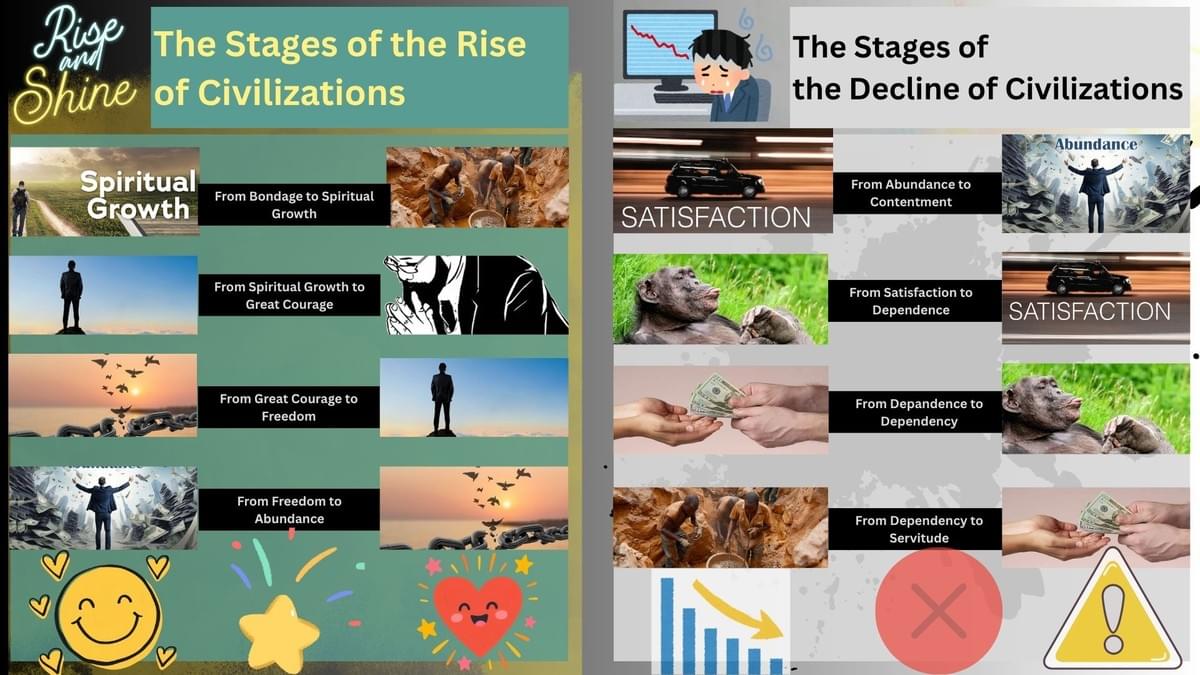
One of God’s social laws is the principle of gradual progression
Have you ever seen a towering edifice that did not originate as a sketch on paper? Have you ever known a woman to conceive and give birth on the same day? Have you ever seen a successful person who did not endure sleepless nights? Such is God’s law for His creation—so much so that it has been said: "No great building exists that was not once a sketch on paper, and no revered monarch exists who was not once a crying infant." It matters not who you are today; what matters is who you will be tomorrow. With this in mind, let us say that a person’s value lies in what they do well. Just as everything in life follows a process of gradual development, civilizations are built through effort and destroyed by neglect. What, then, is the value of a person who fails to prioritize the most important matters over the merely important ones?
First: Factors in the Decline of Civilizations
1- From Abundance to Complacency
The complacency implies self-satisfaction and a growing disregard for dangerous trends that undermine health and the capacity to flourish. Everything appears to be fine—and is assumed to remain so—even as essential institutions, resources, infrastructure, and virtues crumble. Virtues, guiding principles, and ideals remain out of reach, while those who sound the alarm are branded "killers" by the complacent and dismissed as extremists, harsh, or judgmental.
2- From Complacency to Apathy
The word "apathy" is derived from Greek and denotes a lack of interest or passion for things that were once impactful and inspiring. Stemming from the complacency of the preceding stage, this growing apathy leads toward total detachment; few people reflect on or care about the sacrifices made by earlier generations, and the sense of obligation to work for and contribute to the common good is lost. "Civilization" suffers a severe blow as it is supplanted by privatization, and the willingness to work and sacrifice for others increasingly fades away. Growing numbers of people are content to live off the fruits of past sacrifices; they will pay a mere penny to have someone else park their car rather than feed the parking meter themselves. Hard work and self-discipline continue to erode.
3- From Apathy to Dependency
An increasing number of people lack virtue and the drive to work and contribute. The suffering and sacrifices that built this culture have become a distant memory. As discipline and hard work appear "too difficult," dependency is on the rise. The collective culture is now shifting toward dependency. Suffering—of any kind—seems intolerable, yet virtue is not seen as the solution. Having lived off the sacrifices of others for years, the civilization now insists that "others" must solve its problems. This signals a growing demand for collective and government-led solutions. This, in turn, deepens dependency, as solutions shift from personal virtue and domestic or familial sacrifices to fundamental sacrifices.
4- From Subjugation to Slavery
The history of slavery has played a pivotal role in shaping our modern world, and its impact persists to this day. This is evident in the widespread—and sometimes systemic—racism that continues to target people of African descent in particular. Its origins lie in various historical factors used to justify the alleged "inferiority" of Africans, including during the Enlightenment. Furthermore, the slave trade, which laid the foundation for the economic dominance of colonial powers, caused profound disruption to social structures across Africa.
Secondly: The Stages of Ascent
We have explored the factors behind the decline or collapse of civilizations, realizing how easily individuals, groups, societies, nations, or even entire peoples can succumb to them. What matters most, however, is an awareness of the factors that drive ascent. After all, failure serves only to teach us how to succeed and rise again; without opposites, we would not truly understand things. Let us now examine the factors behind the rise of civilizations as described by anthropologists—scholars of humanity—so that we may grasp them and appreciate their significance for each of us. Civilizations are not built merely by reading books, but by the hands of those who have read them. If a thousand books were placed on a table for a century, nothing would change; yet, if a single person were to read those thousand books, they could transform the world around them. As you navigate life, you might label one person "savage" or "barbaric" and another "civilized." How do you arrive at such judgments? You do so based on standards of knowledge, do you not? Without knowledge, you would have no such standards and would not form these internal judgments. We do not judge people haphazardly or voice these opinions publicly; rather, they remain within our private selves—eventually proving to be either correct or incorrect. Most importantly, let us now explore the factors that drive the rise of civilizations—but remember: civilization begins with *you*. So, let us begin.
From Bondage to Spiritual Growth
The great civilizations are forged in the crucible of bondage. The ancient Jews were enslaved in Egypt for 400 years. The Christian faith and the Church emerged after three centuries of persecution. Western Christianity arose from the chaotic struggles accompanying the collapse of the Roman Empire and the often-ferocious movements of "barbarian" tribes. American culture was shaped by the oppression that developed during the colonial era. Pain and injustice foster—and indeed strengthen—spiritual growth; pain brings wisdom and demands a spiritual discipline that seeks justice and solutions.
From Spiritual Growth to Great Courage
Tempered by suffering, courage and the capacity to endure immense sacrifice emerge. Exceptional leaders arise, and people are called upon to show courage and make sacrifices—even at the cost of life itself—to build a better, more just world for future generations. Those who possess little or nothing have little or nothing to lose, and they are often more willing to live for something greater than themselves and their own gratification.
From Courage to Freedom
As a result of valorous combat, the enemy is defeated, and freedom and great justice emerge; from this, a civilization rooted in high ideals arises. Many who led the battle remain alive, and the legacy of those who have passed endures. The heroism and virtues that secured freedom are still cherished, and the ideals for which people struggled remain largely upheld.
From Freedom to Abundance
The freedom heralds greater prosperity, as the civilization continues to operate on the virtues of sacrifice and hard work. Yet, the first danger emerges: abundance. Things in excessive abundance weigh us down and take on a life of their own. Simultaneously, the struggles that generate wisdom and fortify the spirit—instilling discipline and sound priorities—recede into the background. This culture subsists on the remnants of past sacrifices, while its people become less willing to make such sacrifices themselves. Ideals diminish in importance, and abundance burdens the souls of the citizenry. The sacrifices, discipline, and virtues responsible for the civilization’s flourishing drift further from the collective consciousness, while enjoying the fruits of that prosperity becomes the primary focus.
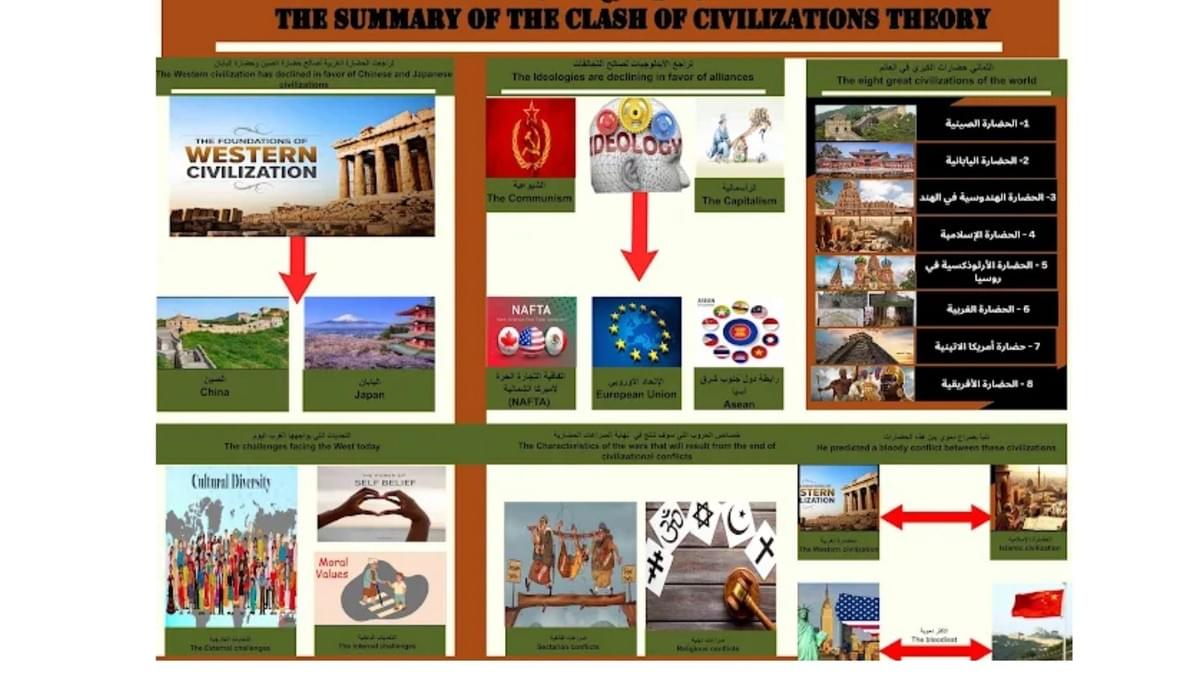
This book is considered a seminal work in global politics and international relations. In the wake of the Cold War, Samuel’s theory of the "clash of civilizations" offered a distinct perspective on the future trajectory of politics. The theory reshaped the international order by grounding it in eight civilizations, each with its own unique values and institutions; from Samuel’s viewpoint, the post-Cold War world was moving toward cultural pluralism. This implies the absence of a single global civilization and suggests that nations align themselves based on their respective civilizations.
Huntington divided the world into eight major civilizations:
1- Sinic (Chinese) Civilization: encompassing Vietnam, China, and Korea.
2- Japanese Civilization: in Japan.
3- Hindu Civilization: in India.
4- Islamic Civilization: spanning the Arabian Peninsula, North Africa, the Iberian Peninsula, Central Asia, the Arab states, Turkey, the Persian realm, and Malaysia.
5- Orthodox Civilization: in Russia.
6- Western Civilization: in Europe and North America.
7- Latin American Civilization: in the Catholic and authoritarian nations of Central and South America.
8- African Civilization: in African nations.
Samuel predicted a bloody clash between civilizations.
There is a divide between Islamic civilization and Western civilization—represented by North America and European nations. The roots of the conflict between these two civilizations lie in several factors:
The resurgence of Islam
The decline of Communism
The West's attempt to universalize its values; and
Increased interaction between the two, which highlighted their differences.
Nevertheless, Samuel predicted a broader conflict between the United States and China. He declared that the clash between the U.S. and the combination of Chinese military might with the economic power of East Asian nations (ASEAN) would be the world's most significant conflict. He further noted that Islamic civilization was the most concerning; people in the Arab world do not share the general assumptions of the West. Their primary allegiance is to their religion, not their nation-state, and their culture is unreceptive to certain liberal ideals, such as pluralism, individualism, and democracy.
What are the characteristics of the wars that emerge from these civilizational conflicts?
They are sectarian conflicts involving individuals or groups from different civilizations—typically belonging to different religions—who clash primarily for control over populations or territories. These are the most enduring wars of the new world order, as many of them arise through a cascading chain reaction.
The sectarian and fault-line wars stem from historical differences, demographic factors, and political and economic causes within civilizations.
The examples of such conflicts include
The strife between Muslims and Hindus in the Indian subcontinent, conflicts in the South Caucasus between Armenia and Azerbaijan, and conflicts in Central Asia involving the Balkans, Russia, and the Turks.
These conflicts result in
A large number of casualties and refugees.
In the concluding part of his theory, Samuel discusses the West's position in the world.
He argues that the West must recognize its power is in relative decline. Policymakers in Western nations—particularly the United States—need to adjust their strategies in response to the shifting structure of global affairs and the rising influence of non-Western states.
Regarding the internal and external challenges facing the West:
The internal challenges
The stem from differences in values, morals, and beliefs among Western populations themselves.
The external challenge
The stems primarily from global cultural differences.
To confront these challenges, he proposes:
Achieving greater military, economic, and political integration.
Admitting new nations into the European Union and NATO.
He advises the West—and the United States in particular—to:
Adapt to the growing power of non-Western civilizations. He calls on the West to strengthen cooperation with other civilizations through deeper military, economic, and political integration. Furthermore, the West should incorporate Central European nations—including the Visegrád Group, the Baltic states, Slovenia, and Croatia—into the European Union and NATO. Above all, the West must refrain from direct military intervention in the affairs of non-Western states, as such actions pose a direct threat to global stability. These measures would help the West remain a global political power while preserving world peace and stability. Failure to do so would lead to global conflicts, threatening world peace as a whole.
The Links
