

What is fish farming?
The fish farming refers to the rearing of various fish species—whether saltwater or freshwater—intended for human consumption. This process takes place under controlled conditions and human supervision within specific enclosures, such as rearing ponds or cages, with the aim of boosting production and securing the farmer's ownership of the produce.
Despite Egypt's success in freshwater fish farming,
The country still imports approximately 193,000 tons of fish
while exporting around 700 tons.
The Fish for Export
Sea bass and sea bream—
both marine species—
are the most export-viable fish in Egypt,
accounting for 90% of the country's fish exports;
they thrive in standard fish farms.
Since 2023, The imports have been limited to
A certain premium marine products,
such as fish fillets
and jumbo shrimp.
The fish species not produced in Egypt
Such as herring, mackerel, and salmon—must be imported to meet consumer demand. These imported varieties are often lower in price than locally produced fish, making them accessible to all segments of society, particularly low-income groups, and helping to balance the Egyptian fish market. Aquaculture farms are essential for meeting global demand for seafood, as they account for a significant share of global production, they alleviate pressure on potentially overexploited wild fisheries while providing a reliable source of food and employment opportunities. Furthermore, aquaculture can help improve food security in many coastal and developing regions.
A General Information to Consider
In light of continuous population growth, Egypt has turned to fish farming to bridge the food supply gap. This approach involves:
1- Expanding the production of new, high-quality, fast-growing fish breeds to meet local market demand and, consequently, reduce import levels.
The Workforce in Egypt's Fisheries Sector
The number of workers in the fishing sector is estimated at approximately 165,000. This figure rises to around 200,000 when including all economic sectors related to fishing, distribution, and processing.
The Fisheries' Share of Production Value
According to the General Authority for Fish Resources Development, the fisheries sector accounts for approximately
4% of the total value of agricultural production; and
About 15% of the value of livestock production.
Furthermore, current fish production generates revenue estimated at around 6 billion Egyptian pounds (with the dollar equivalent to 557.75 Egyptian pounds).
The comparing Egypt's average annual per capita fish consumption with that of other countries:
It is notably low, ranging from 2.5 to 6 kilograms, whereas it stands at 35.9 kilograms and 26.1 kilograms annually in Japan and Spain, respectively.
Egypt's annual per capita fish consumption is compared against the benchmark set by the World Health Organization, which is estimated at over 11 kilograms per year. The low per capita fish consumption in Egypt is attributed to limited fish production; Egyptian fish output accounts for 2.5% of Africa's total production, which in turn represents 6.3% of global production.
The marine fisheries rank second among sources of fish production in Egypt; however, output from these fisheries remains low relative to their surface area.
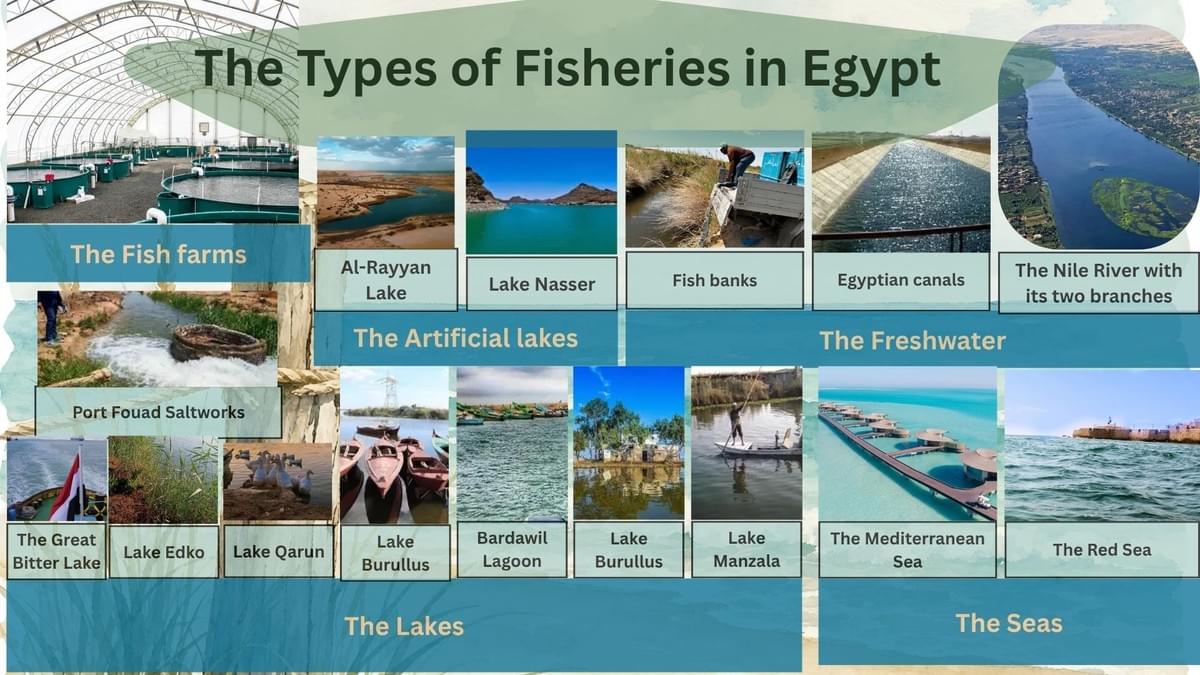
The Fisheries in Egypt cover vast areas exceeding thirteen million feddans—an area equivalent to approximately 150% of the country's agricultural land. These sources vary in nature and include:
a - The Seas
Such as the Red Sea and the Mediterranean Sea.
b - The Lakes
Including Lakes Manzala, Burullus, Bardawil, Idku, Qarun, Mariout, and the Great Bitter Lakes, as well as the Port Fouad Saltworks.
C - The Freshwater sources
The Nile River (with its two branches)
The Canals
The Drainage canals
D - The Artificial lakes
Lake Nasser
Lake Rayyan
E - The Fish farms
The area suitable for fishing in the Red Sea is approximately 4.4 million feddans, and the area suitable for fishing in the Mediterranean Sea is approximately 6.8 million feddans.
The Fish Productivity in Egypt
The fish farming is considered a low-cost method of protein production compared to other forms of livestock farming, such as red meat and poultry production.
However, the past two decades have witnessed significant expansion in the aquaculture sector; this growth has become vital for bridging the food gap and keeping pace with continuous population growth. Aquaculture projects have diversified to include various systems, ranging from extensive and semi-intensive to intensive farming.
The government-run fish farms (which rely on ponds)
It's cover an area of approximately 105,000 feddans, with yields ranging from 1.2 to 3.5 tons of fish per feddan. This productivity is 10 to 15 times higher than the yield per feddan in natural fisheries (seas, saltwater bodies, and freshwater lakes). In addition to government farms, there are private sector farms covering nearly 28,000 feddans, as well as 440,000 feddans of rice fields utilized for raising carp.
Since 1970,
The volume of farmed fish production in Egypt has risen from 1,000 tons to 400,000 tons by the end of 2000. Farmed fish currently account for 50% of Egypt's total fish production.
The Key Milestones in Egyptian Fish Farming
1978
An agreement was signed between the US agency and the Ministry of Agriculture to establish a fish farming development project in Egypt.
1986
The experimental fish farming operations began.
Late 1991
The project was incorporated into the Agricultural Research Center.
1995
The total production reached 407,000 tons. Fish farms accounted for 18% of this output (72,000 tons), while 141,000 tons were imported to bridge the supply gap. Fish farm production continued to rise in subsequent years.
2000
The year 2000 marked a surge in fish farm production—considered a peak year—with a total output of 724,000 tons. Fish farms contributed 340,000 tons, representing a 47% share.
2001
The fish farms accounted for 44% of total production. With a total output of 772,000 tons, fish farms produced 343,000 tons, while the 261,000-ton supply gap was met through imports.
During 2025,
The fish farming sector witnessed notable developments. Moselhi highlighted a series of positive advancements, most notably the expansion of aquaculture projects and the establishment of modern farms, alongside increased species diversity—particularly in marine aquaculture. He added that the sector also moved toward enhancing the quality of fish products by implementing global quality standards across various farms and products, thereby boosting competitiveness and increasing demand in both domestic and international markets.
The sources of domestic fish production
1- Marine fish
Sea bass
Sea bream
Grouper
Sardines
Sea bream (Pagrus)
Whiting
Sole
Shrimp, crab, and squid
2- The freshwater fish
Tilapia
Bayad
Catfish
Nile perch
3- The farmed fish
Tilapia
Carp
Mullet
Catfish
The Types of Aquatic Animal Farms
a- Floating sea cages
Salmon farms often utilize floating sea cages.
b- The feshwater tanks / Recirculating aquaculture systems (RAS)
These systems are commonly used to raise species such as:
Tilapia
Salmon
Catfish
...particularly in regions facing water scarcity.
We are familiar with freshwater tanks, but what are recirculating aquaculture systems?
The recirculating aquaculture systems are modern fish-farming setups that rely on reusing water within the farm rather than constantly replacing it.
How does it work?
Water is used in fish tanks.
Water containing waste and leftover feed is collected.
It passes through filtration units to remove solids and contaminants.
It undergoes biological treatment to eliminate toxic substances like ammonia.
The oxygen is added, and water quality is adjusted.
It is recirculated back into the tanks for reuse.
The System Advantages
The significant water savings (over 90% can be reused).
The ability to raise fish at high densities.
It's superior control over water quality and temperature.
It reduced environmental pollution.
The feasibility of establishing fish farms far from major water sources.
The Disadvantages
The relatively high setup and operating costs
Requirement for advanced equipment and technologies
Necessity for continuous monitoring of water quality and electricity supply
C – The Rope/Seabed Farms
The Examples:
The Oysters
The Mussels
The typically located in coastal areas, where they are suspended from ropes or cultivated on the seabed
The decline in fish productivity in marine fisheries is attributed to the following factors
The Low fertility levels in the Mediterranean Sea.
The Mediterranean Sea receiving various pollutants from the countries bordering it.
The high levels of pesticide and chemical pollution flowing into Lake Qarun.
The high evaporation rates due to the large surface area of Lake Qarun, leading to increased salinity and causing the lake's environment to resemble a marine ecosystem.
The continuous construction activity within natural lakes.
The overfishing in these lakes by recreational anglers.
The poor management of tourism investments in the Red Sea region.
The developing tourist resorts instead of utilizing these areas as natural fish-rearing farms.
The continued discharge of industrial and agricultural waste into natural lakes.
The use of *hattatat* (a type of trap) by fishermen in the same lake; these devices kill thousands of shrimp that congregate in specific areas of the lake.
Additionally, the northern coasts are home to a predatory fish known as the "sea rabbit" (pufferfish).
These fish threaten Egypt's fisheries by devouring large quantities of the fish species that inhabit and breed in these areas, thereby harming fish stocks.
There are also crocodiles in Lake Nasser...
Which consume over 135 tons of fish daily and pose a threat to the lives of fishermen.
The Central Laboratory for Aquaculture Research identifies pollution as a major challenge facing the development of fish farming in Egypt, as it impacts both the quantity and quality of fish production.
The research highlights the impact of agricultural drainage water—resulting from the discharge of 5.3 million tons of fertilizers and 20,000 tons of pesticides, alongside industrial waste and other pollutants—as well as petroleum spills, which lead to the death of tons of fish. Furthermore, feed shortages caused by high prices significantly affect the aquaculture process; farmers are often compelled to use conventional livestock feed or improvised feed mixtures, resulting in reduced fish quality.
